Hollow Pin
Northern Alberta · fictionalizedA recurring location in Marc’s story, where the ledger begins to narrow and the warning becomes personal. The exact real-world location is intentionally withheld.
“The truth is rarely buried. More often, it is overwritten.”
A father builds a system to find the pattern behind the boogeyman that followed him out of childhood. The closer he gets, the more the system begins to learn him.
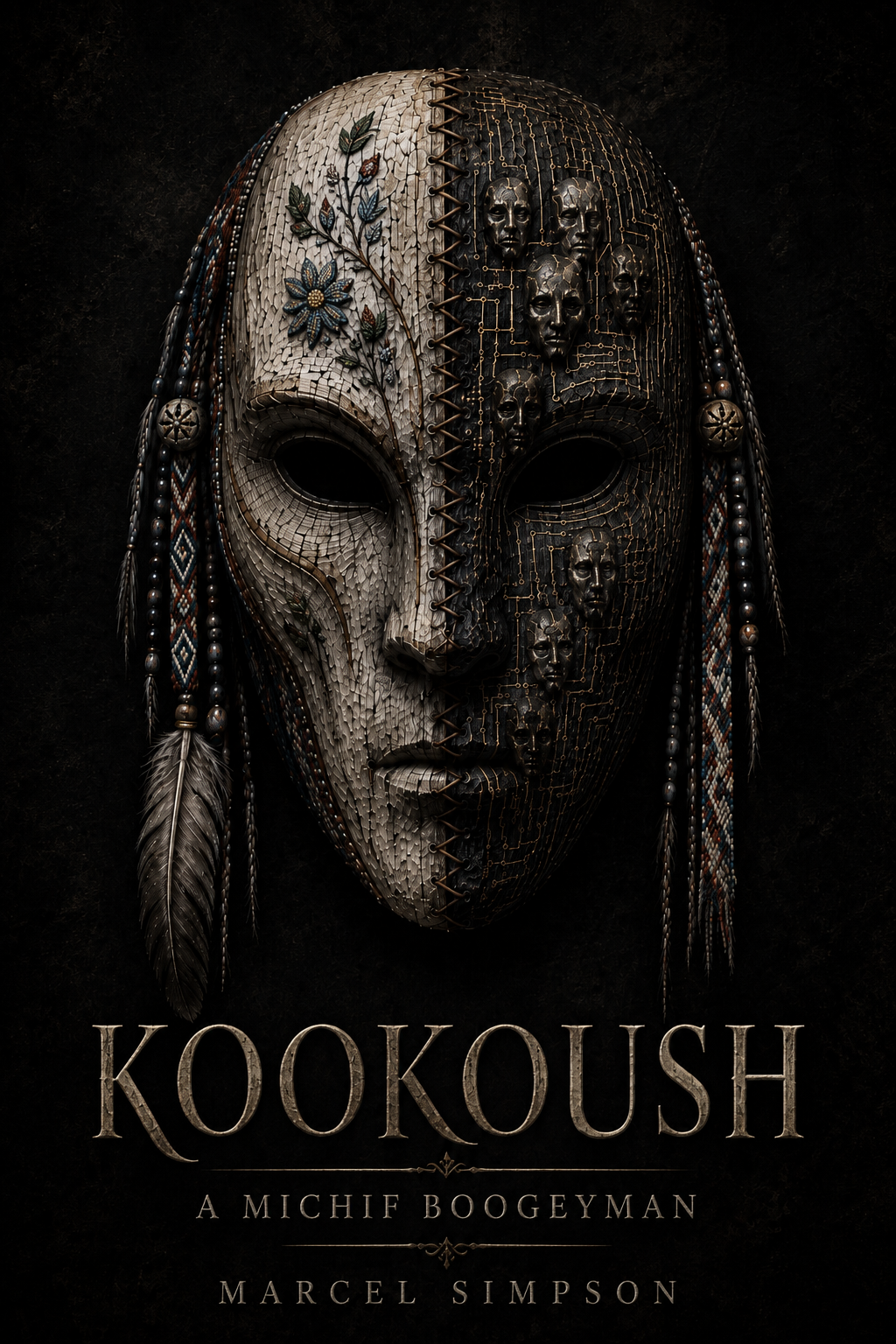
KOOKOUSH is a contemporary Métis supernatural thriller about family, memory, colonial records, artificial intelligence, and the danger of letting any system decide which stories deserve to survive. It is told through Marcel Simpson’s own lived experience, research, imagination, and fictional lens.
Track the pattern. Prove it’s only a story. Keep his family safe.
Then the map starts filling in by itself.
Pins appear where no one has been. Reports arrive with details no one submitted. The system begins suggesting new coordinates — like it isn’t measuring the legend, but advancing it.
The more Marc records, the more it learns him: his routines, his voice, the shortcuts he takes when he’s tired, the words he uses when he’s scared.
Because Kookoush doesn’t need the woods anymore. It can live in the record — what gets labelled, what gets dismissed, what gets quietly rewritten until everyone agrees it never happened.
Marc has one move left: a trail the machine can’t edit.
Painted stones. Printed pages. A book.
This map is a narrative extension of the novel, not a requirement for understanding it. Identified and Witnessed are fictional Stone Ledger terms from the story, not real-world case classifications. Locations are intentionally broad and do not identify sacred sites, private property, or verified supernatural events.
The interactive map is optional. Every narrative marker is listed here so the ledger remains readable when scripts or map tiles are unavailable.
A recurring location in Marc’s story, where the ledger begins to narrow and the warning becomes personal. The exact real-world location is intentionally withheld.
The schoolhouse and threshold material: a warning reduced by the system to clean procedural language.
A fictionalized landing shaped around hunger, restraint, law, and records that make violence sound administrative.
A saved location appears without Marc asking for it, pushing the ledger toward another crossroads. The map position is approximate.
The pattern moves into a modern urban setting: controlled hunger, obedience, and a coordinate that feels more like an invitation than evidence.
A composite marker about famine, accusation, punishment, and the power of labels to turn fear into procedure.
The map expands across shipping routes, penal records, and colonial hunger, forcing Marc to ask whether the global pattern is evidence or bait.
KOOKOUSH draws on Marcel Simpson’s lived experience, family memory, research, and imagination. The Stone Ledger and its supernatural interpretation are fictional devices created for the novel. They are not presented as universal Métis or Indigenous teachings.
View sources & cultural note